The privatisation of NHS England (whether the government and politicians want to admit it or not), this is exactly what I do not want to see the direction Malaysia MOH is heading in future.
Our MOH has performed well for the battle against COVID-19 thus far, we have our public health practitioners, allied workforce and health management bureacrats (all are 'civil servants') to thank for. Most of all, our MOH still have direct control of the public healthcare services, can coordinate quickly, deploy personnels and resources, expand the capacity, and carry out the decision as quickly as possible. Time is the most precious thing during the fight against the deadly virus, government has to act decisively and proportionately at the right time. Fortunately we have a more cohesive, less fragmented health system with proper governance.
Imagine if our government still have to negotiate with many private sector players and reach an agreement on the pricing, labour and administrative matters? A certain association even defended a private hospital (its member) for jacking up the price outrageously to a poor patient for the face masks used by their own staffs, imagine our government has to settle with them...
See how NHS England is crippled by many functions being outsourced/privatised (while their own departments being downsized), until themselves do not have the ability to rapidly respond, scale up and mobilise their own resources especially during health emergency like COVID-19... note how much budget cuts the local health authority have received over the years, that is deadly to their public health service delivery.
.>> 我特別讚賞政府為了鼓勵員工在家工作(Work from home)而提供獎掖給公司購買電腦、手機等配備,還要求電訊公司白天開放免費的1GB網路給使用者,甚至提供津貼給家長送孩子去托兒所,這樣能確保員工能有效地在家工作。在這一點,政府配合公共衛生防疫措施的舉動,心口合一。高招的設計是,政府要僱主買的電腦才算數,避免員工因個人喜好購買和領取政府的獎掖。
若说换政府倒纳吉是目的,有者表示这已成功了,信誓旦旦不后悔。他们坚持上届大选必需依赖马哈迪这个“招牌”首相人选才能造就历史性换政府。他们也相信换政府是为了开启制度改革、伸张正义,重建国家社会必经的一步。我们固然应当追求这些最终目的,但我坚持公义的手段达至公平正义的结果(just means lead to just ends)。即使不提手段只论结果,也要反省当初的选择是否真能导向所期望的结果,比如制度改革。
他们俩互相厌恶撕破脸皮的戏码记忆还犹新,特别是在(3月1日慕尤丁宣誓就任第8位首相)马哈迪重返相位的计划确定被打败了后,他就毒舌起来。记得他说什么吗?他怪安华gila-gila nak
jadi PM, (发狂就是为了当首相),还说安华不行因为没多少人支持他。两周后他又在媒体怪罪安华一直策划要他早日下台。安华过后接受采访时也说他不再相信马哈迪。上个月他回敬老马问说到底是谁疯狂恋权要在90多岁继续当首相。
Original title: The need to maintain an
independent and principled civil society movement
***
MAY 9 was supposed to be a day for Pakatan Harapan MPs, workers and supporters to celebrate the pact’s 2018 election victory.
However, the dramatic political conspiracy and scheming widely known now as the “Sheraton Move” took place at the end of February, to the bewilderment and disgust of the entire nation.
While the drama was orchestrated by the political elite, have civil society organisations and individuals reviewed their strategies and approaches with regard to what they achieved – or didn’t – during PH rule?
It is an understatement, to say the least, that the PH government disappointed many reform-minded supporters, with few achievements to show for, let alone the promised paradigm shift in policies, in its nearly two years in Putrajaya. Even the “good and widely praised” persons appointed to certain public offices face removal given the change of government. Institutional reform should be entrenched and permanent, unlike mere mortals in the hot seats.
What lessons can be learnt? Before the 14th general election, there were some civil society leaders who tactically threw their support behind PH and its choice of prime minister, whose track record is tainted with autocracy, cronyism, racism, abuse of state institutions and crackdowns on democratic demands for reform. And yet, some still harboured hope that he would change his spots under the PH banner. Overthrowing the Barisan Nasional government, and especially Najib Razak, became PH’s primary, if not sole, agenda.
For the organisations that had worked hard to realise their causes over the past 20 years, there was great temptation to see their reform efforts finally bear fruit. Instead of maintaining an independent stance, however, some decided to take the partisan line and campaigned for one side’s candidates. The sloganeering reached nauseating levels and the patriotism card was frequently flashed with claims to “save Malaysia” or “prevent the country from going bankrupt”. Some went as far as to reassure the people that PH was “not the same” as BN, and would “share power equally”. Most of all, it would “keep in check” the person at the helm.
Some civil society figures, among them former Bersih 2.0 chairman Maria Chin Abdullah, joined PH, and contested and won the elections. Others were happily “co-opted” into the system later. Hopes and expectations were high then.
Two years later, we know how the story goes. Those who might have misled the people during the GE14 campaign now have many excuses, but not a single apology. No promise or manifesto has been outlined by the Perikatan Nasional government, which has said its focus is fighting Covid-19. The hope for reform appears to have diminished, and we are back to square one.
Where should progressive, reform-minded civil groups go next? Should they still pin their hopes on one coalition, rising and falling with it?
It is activism gone wrong when such groups identify themselves more with those who hold power than the grassroots movements from which they derived their legitimacy. This happens when civil society leaders see themselves as the elite and believe that societal change can happen with back-room power brokering – the friendlier the party they get accustomed to, the higher the chance of success, or so they think.
I hope the bitter experience of the past two years will change their perspective, and for social movements to return to the basics: alerting, educating, inspiring and empowering the public as part of a participatory democracy built on universal values and principles.
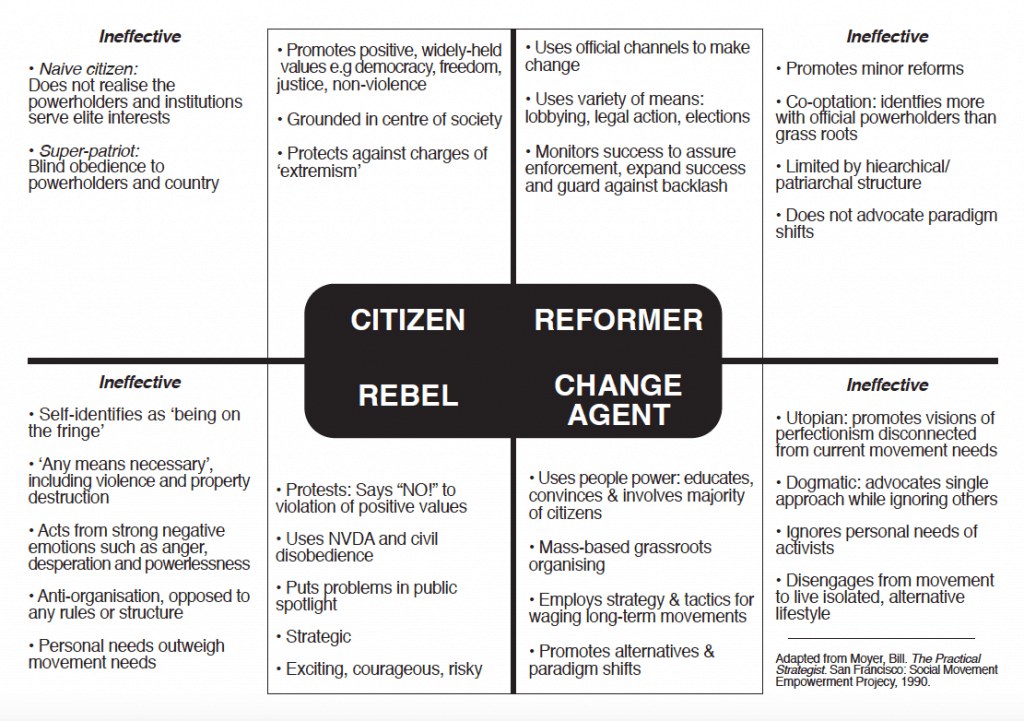
Perhaps, there’s no better time than now to study social activism theorist Bill Moyer’s work on the Movement Action Plan, which clarifies the nature and dynamics of social movements, and provides a framework for organising and building them. He reminds us that a social activist has four roles, namely citizen, rebel, change agent and reformer, which varies according to a movement’s stages.
There are effective and ineffective ways to carry each role. For example, the ineffective “naive citizen” tends to have too much faith in power-holders and institutions serving the public’s interests over those of the elite. The “super-patriot”, meanwhile, is automatically obedient to power-holders in the name of the country. “Any means necessary”, as opposed to “means equal ends”, is a grave mistake that demands a heavy price. Giving tacit support to a suspicious leader is a good example; that’s a big gamble indeed.
Also, the self-identified leaders of certain issues may be too elitist, impeding the growth of social movements. Those who promote minor reform as a compromise, or allow for “co-optation”, are also ineffectively playing the role of change agent and/or reformer.
Maintaining the independence and integrity of civil groups is as crucial as keeping their core principles. Being part of social movements doesn’t mean one must always rebel. Equally, effective advocacy and lobbying doesn’t suggest a need to lean over and take a partisan line, or be co-opted. Regardless of how desperate or hopeless a situation seems, social movements should not take shortcuts.
I believe that a healthy and vibrant participatory democracy should reflect the “people power” structure: a strong, independent and principled civil society with an active citizenry that embraces universal values. This should serve as the backbone of our democracy.
Power-holders, even if derived from an electoral democracy, do not own absolute truth, and they are not our bosses. There’s no reason for civil society to bow to them. – May 11, 2020.
* Dr Lim Chee Han is a founding member of Agora Society and senior researcher at Third World Network. He holds a PhD in infection biology from Hannover Medical School, Germany, and an MSc in immunology and BSc in biotechnology from Imperial College London. Health and socioeconomic policies are his concerns. He believes a nation can advance significantly if policymaking and research are taken seriously.
The need to maintain an
independent and principled civil society movement
9th May is supposed to be a day for the Pakatan Harapan
members of parliament, party workers and supporters to celebrate their
anniversary of success, but this year is different. The dramatic political
conspiracy and betrayal scheme were timely and swiftly played out by the end of
February (famously known as the ‘Sheraton Move’ today) as the naked power
struggle and horse-trading exercise bewildered and disgusted the whole nation.
While the drama was exclusively played by the political elites, have the civil
society organisations and individuals reflected and reviewed their strategies
and approaches with what they had achieved (or not) during the PH government
rule? It is an understatement to say the least that the PH government has
disappointed many reform-minded supporters because of the little achievements to
show in nearly 2 years of rule. There have been too little reform, let alone a
paradigm shift in policies and institutional reform which the PH has promised.
Even the ‘good and widely praised’ persons appointed to certain public offices,
would face the consequence of removal given the change of government.
Institutional reform should be more entrenched and permanent than just some
mortals in the hot seats.
What lessons can be learned? Before GE14 there were some CSO leaders
who tactically threw in vehement support for the PH coalition and rallied
behind their prime minister candidate whose past records had been tainted with
autocracy, cronyism, racism, abusing state institutions and cracking down on democratic
demands for reform. Yet some still harboured the hope that the candidate would
change his spots under the PH banner. Overthrowing the longstanding BN
government and especially Najib Razak as the sitting prime minister had become
their primary objective, if not the only agenda.
For the organizations or movements who had been working so hard to
realize their causes in the past 20 years, that was a great temptation –
whether one calls it a desperate or opportunistic move, to see their reform
efforts finally bear fruits in the end. However, instead of maintaining their
independent and principled stance, some organisations and individuals decided
to take the partisan line, and heavily campaigned for the candidates from one
side. The campaign sloganeering reached a nauseating level, flashing out the
patriotic card such as claiming to ‘Save Malaysia’ or ‘prevent the country from
going bankrupt’.Some would even go as
far as‘reassuring’’ the people that the
PH coalition is ‘not the same’ (as BN), as they would ‘share power equally’,
and most of all they could ‘keep in check’ the person at helm.
Some members from the CSO joined PH, contested and won in the last GE (eg. Bersih 2.0 ex-chairperson
Maria Chin Abdullah), and some others from CSO within were
happily being ‘co-opted’ into the system later. Hopes and expectations were
indeed high at that moment. We know how the story went about 2 years later, yet
those who may have misled the people during the GE14 campaign, now seem to have
other words of excuse, anything but apology. No promises or manifesto have been
outlined by the current Perikatan Nasional (PN) government who claim their
focus now is on fighting over the COVID-19, the hope of reform seems diminished
and back to square one.
Where should the progressive and reform-minded CSOs and individuals go
next? Should they still hinge their hope on one political coalition, rising and
falling with the latter? Here I would argue that such model of activism or
social movement has gone wrong, due to the CSOs’ personnel identifying
themselves more with the powerholders than the movement grassroots which the
social activists should have derived their legitimacy from. This may happen
when the social movement leaders see themselves as the elites and believe that
societal change could happen due to power brokerage in the backroom – the more
friendly the party they get accustomed with, the higher the chance of success,
or so they think. I hope the bitter experience of the past two years would
change their perspective, and the social movement needs to go back to the
basic: alerting, educating, inspiring and empowering the general public, as
part of participatory democracy, and must be built on universal values and
principles.
Perhaps there is no better time than now to devote some time to the
social activism theorist Bill Moyer’s work (2001)
on Movement Action Plan (MAP) which clarifies the nature and dynamics of social
movements and provides a framework for organising and building them. Bill
reminds us that a social activist has four roles to play: citizen, rebel,
change agent and reformer
(see Figure 1 below), varies according to the stages of
social movement. However, there are effective and ineffective ways (or
pitfalls) to carry each role. For example, the ineffective role of citizen
would be ‘naïve citizen’ who tend to have too much faith in the powerholders
(ie. right people in the hot seat) and institutions to serve their interest
instead of special elite interests; or ‘super-patriot’ who gives automatic obedience
to powerholders in the name of country. ‘Any means necessary’ is a grave
tactical mistake with a heavy price to pay later (as opposed to ‘means equal
ends’)-- giving tacit support for a highly suspicious political leader the rein
in governance is indeed a big gamble and one good example of ‘any means
necessary’. Those self-identified leaders of certain issues/agendas could be
too elitist, impeding the growth of movement (certain environmental movement in
Kuantan was once plagued with the issue); those who promote minor reform as
compromise or allow ‘co-optation’, these are identified as ineffective way of
playing the role of change agent or reformer.
Maintaining the independence and integrity of a CSO or movement is as
crucial as keeping the core principles. Being in the social movement does not
mean that one must always rebel. Equally, effective advocacy and lobbying do
not suggest that there is a need to lean over to take a partisan line or to be
co-opted. Regardless of how desperate or hopeless the situation seems, the social
movement should take no shortcut but have its foundation built from the ground
up.
I believe a vibrant and healthy participatory democracy should reflect
the ‘People Power’ structure: a strong, independent and principled civil
society with active citizenry embracing universal values. This should serve the
backbone of our democracy. Powerholders, even if derived from electorate
democracy, do not own absolute truth and they are not our boss, a reason why civil
society does not need to bow to them.