Thursday, April 06, 2023

森林保护是防洪的前沿上策

 气候变化带来的破坏及影响越来越严重,暴雨来袭似乎更频密而且更强烈。马来西亚许多高风险的地区,更常看到灾难性的水灾和土崩事件。大家可能还记得近年来在我国所发生的严重洪灾事件,而这些灾害祸地,在过去几十年前这些现象倒是罕见。

根据联合国2021年的研究报告,除了被列为“暴雨”的天数增加之外,我国的年度降雨量强度也有明显增加:对比30年前,2000年至2007年期间,一小时、三小时和六小时的降雨长度的发生率分别增加了17%、29%和31%。

报告还发现,大约2万9800平方公里的我国土地或会受到年度洪水的影响,多达500万人可能处于风险之中。据估计,在12年后,仅因气候变化而可能遭受极端河流水位上升造成洪水波及的人口就有10万2290人。

毋庸置疑,政府必须提早规划和投资于防洪措施。前任首相依斯迈沙比里领导的政府当时宣布,从2023年到2030年将增拨150亿令吉,平均每年支出19亿令吉来防洪。

这笔增加的财政预算拨款将用于几个项目,以加强防洪减灾努力。在最新修订的2023年联邦财政预算案当中,主要的高额支出拨款项目是用于:一、防洪计划(RTB)和城市排水(10亿令吉),二、河口疏浚(2.08亿令吉),三、防止海岸侵蚀(1.77亿令吉),四、提升基础设施和城市排水、防洪(1.18亿令吉)。

然而,我认为,洪水的发生及其造成的严重影响,不能纯粹归咎于降雨量的增加和气候变化。只有当造成水灾的其他原因(除了雨水)能够获得正视和积极解决时,减轻洪灾冲击的措施才能奏效。因此,我促请政府考虑通过宪报森林保留地和重新造林,作为防洪措施的前沿上策。

相比之下,我在2023年财政预算案中发现,目前的生物多样性保护生态财政转移计划(Ecological Fiscal Transfer for Biodiversity Conservation,EFT)只获得分配了1.5亿令吉,约占防洪拨款的8%。

EFT是一个各级政府之间财政转移机制,根据商定的原则和优先政策,将联邦拨款分配给各州政府,目的是要保持或扩大森林保护区的面积大小和质量。自2019年起,EFT已成为了联邦政府的政策。

应展示领导人政治意愿

这个数字与联邦政府今年拨款给推广旅游项目的数额相比又如何?推广旅游项目获得2.5亿令吉。政府还计划耗费4.8亿令吉,欲在金马仑高原兴建从哈布到丹那拉塔的新道路,以缓解交通拥堵。单单这一条新道路已是今年EFT拨款的三倍。

政府应通过未来的EFT拨款预算,展示领导人的政治意愿和承诺。有关防洪减灾的拨款预算,政府也应考虑采纳类似EFT方案,尤其是拨款给位于洪水灾害风险地区,加强保护森林。政府应把更多的努力集中在水灾问题源头,这样才能有效防止灾难一再发生,因为森林是最好的天然集水区,可以减少土壤侵蚀以及河流的淤积。

群议社社长林奕慧就曾撰文论证,为何建造更多的防洪水坝,从长远之计来看,对防洪目的来说是没有帮助的。那是因为有更多的淤泥会在水坝堆积,进而降低了控制和阻挡径流水的效果。但为何会有更多的淤泥?那是因为砍伐森林意味著更多的土壤可能被冲下河或进入排水系统,而那里的树木曾经帮助稳住了这些土壤不让流失。

挖掘加深河床和建造混凝土水坝或防洪屏障或只能是被动的短期应急措施,这些措施对环境造成了更深远的严重影响,特别是这些建设或机械工程对周遭环境的破坏、对河川生态系统构成了重大伤害,其中包括摧毁了鱼类和其他水生生物的生态环境。若能,政府应尽量避免这些工程,让自然环境成为防洪的最前线堡垒。


刊登于《東方日報》《群議良策》專欄2023年4月5日 

東方臉書鏈接

Monday, April 03, 2023

𝗙𝗼𝗿𝗲𝘀𝘁 𝗽𝗿𝗼𝘁𝗲𝗰𝘁𝗶𝗼𝗻 𝗮𝘀 𝘁𝗵𝗲 𝗳𝗿𝗼𝗻𝘁𝗹𝗶𝗻𝗲 𝗼𝗳 𝗳𝗹𝗼𝗼𝗱 𝗽𝗿𝗲𝘃𝗲𝗻𝘁𝗶𝗼𝗻 (Unedited original article)

𝗙𝗼𝗿𝗲𝘀𝘁 𝗽𝗿𝗼𝘁𝗲𝗰𝘁𝗶𝗼𝗻 𝗮𝘀 𝘁𝗵𝗲 𝗳𝗿𝗼𝗻𝘁𝗹𝗶𝗻𝗲 𝗼𝗳 𝗳𝗹𝗼𝗼𝗱 𝗽𝗿𝗲𝘃𝗲𝗻𝘁𝗶𝗼𝗻

𝘔𝘰𝘳𝘦 𝘣𝘶𝘥𝘨𝘦𝘵 𝘧𝘰𝘳 𝘌𝘍𝘛, 𝘱𝘭𝘦𝘢𝘴𝘦!

The impact of climate change in the form of more frequent and more intense rainstorms are becoming more severe. Many vulnerable communities in Malaysia are prone to disastrous floods and landslides. People may recall the incidence of severe floods in Malaysia which took place in recent years, compared to decades ago when floods were rare in the places where recent floods have occurred.
According to the UN Research Report 2021, in addition to the increase in the number of days classified as "heavy rainfall", the maximum annual rainfall intensity has also increased significantly: 17%, 29% and 31% increases in the occurrence of one-hour, three-hour and six-hour rain periods were observed between 2000 and 2007, compared to the periods 30 years ago.
The report also found that some 29,800 square kilometres of land would likely be affected by annual flooding. As many as 5 million people could be at risk. The population likely to be affected by extreme river flooding alone as a result of climate change is estimated at 102,290 people in 12 years' time.
Undoubtedly, it is important for the government to plan and invest in flood mitigation. The previous Ismail Sabri-led government announced that an additional RM15 billion would be allocated from 2023 to 2030, an average expenditure of RM1.9 billion per year.
This increased budget allocation would be used for several projects to strengthen flood mitigation. In the latest revised Budget 2023, the major high expenditure allocations are for: i) Flood Mitigation Plan (RTB) and Urban Drainage (RM1 billion), ii) Dredging of river mouths (RM208 million), iii) Prevention of coastal erosion (RM177 million), iv) Upgrading of Infrastructure and urban drainage, flood mitigation (RM118 million).
However, I argue that the occurrence of floods and the severity of their impacts cannot be attributed solely to increased rainfall and climate change. Flood mitigation can only be effective if the other causes of flooding (besides rain) can be addressed. I urge the government to consider forest protection via gazettement and reforestation as the frontline of flood prevention measures.
What I found in Budget 2023, by comparison, is that only RM150 million is allocated for the current Ecological Fiscal Transfer for Biodiversity Conservation (EFT) programme, which is about 8% of the amount allocated for flood mitigation.
The EFT is a form of intergovernmental fiscal transfer mechanism and redistribution of federal allocations to state governments, based on agreed principles and priorities, with the aim of maintaining or increasing the size and quality of protected forest areas. This programme has been implemented as a federal government policy since 2019.
How does this figure compare to the amount allocated by the federal government for tourism promotion this year? RM250 million. The government also plans to spend RM480 million to build new roads from Habu to Tanah Rata in the Cameron Highlands to ease traffic congestion. This one project is already three times this year's EFT allocation.
The government should demonstrate political intent and commitment by reflecting these measures in future EFT budget allocations. Similar EFT programmes should be considered in the flood mitigation budget, especially for projects located in Flood Hazard Map areas. Additional efforts should focus on stopping the problem at its source, as forests are the best natural water catchment, reducing soil erosion and siltation of our rivers.
My colleague Lim Yi Hui has previously argued why building more sabo dams will not help flood control in the long term, as more silt accumulates at the dam, reducing the effectiveness of a barrier to hold back the runoff water. But why more silt? Because deforestation means more soil could be washed down the river and into the drainage system where trees used to help hold it back.
Deepening riverbeds and building concrete dams or flood barriers are only the reactive measures which pose a more severe environmental impact, particularly environmentally damaging with significant harm to river ecosystems, including the removal of habitats for fish and other aquatic organisms.

Sunday, April 02, 2023

More funding needed to protect forests for frontline flood prevention


As a result of climate change, rainstorms are increasingly frequent and more intense..

Many vulnerable communities in Malaysia live in areas that are prone to floods and landslides.

People may have observed that floods have occurred more often and in a more severe form in recent years than they had in the past.

According to the UN Research Report 2021, in addition to the increase in the number of days classified as “heavy rainfall”, the maximum annual rainfall intensity has also increased significantly. It was observed in 2000-2007 that the latter grew 17%, 29% and 31% in the occurrence of one-hour, three-hour and six-hour rain periods, respectively, compared to 30 years ago.

The report also found that 29,800sq km of land would likely be affected by annual flooding.

As many as five million people could be at risk. The population likely to be affected by extreme river flooding alone as a result of climate change is estimated at 102,290 people in 12 years’ time.

It is vital for the government to plan and invest in flood mitigation.

The previous Ismail Sabri-led government announced that RM15 billion would be allocated to flood mitigation projects from 2023 to 2030, which works out to RM1.9 billion per year.

In Budget 2023, the major expenditure allocations are for: flood mitigation and urban drainage (    RM1 billion); dredging of river mouths (RM208 million); prevention of coastal erosion (RM177 million); and upgrading of infrastructure and urban drainage, flood mitigation (RM118 million).

However, I argue that the frequency and severity of floods cannot be attributed solely to increased rainfall and climate change. Flood mitigation can only be effective if the other causes of flooding is addressed.

I urge the government to consider gazetting and reforesting our forests as a frontline flood prevention measure.

What I found in Budget 2023 is that only RM150 million has been set aside for the current Ecological Fiscal Transfer for Biodiversity Conservation (EFT) programme, which amounts to about 8% of the allocation for flood mitigation.

The EFT is a intergovernmental fiscal transfer mechanism and redistribution of federal funds to state governments, based on agreed principles and priorities, with the aim of maintaining or increasing the size and quality of protected forest areas. The programme was implemented as federal government policy from 2019.

How does this figure compare to the amount allocated by the federal government for tourism promotion this year? RM250 million.

The government also plans to spend RM480 million on new roads from Habu to Tanah Rata in Cameron Highlands to ease traffic congestion. This one project is already three times this year’s EFT allocation.

The government should show political intent and commitment in future EFT budget allocations.

Similar programmes should be considered for inclusion in the flood mitigation budget, especially for projects located in flood hazard map areas.

Additional efforts should focus on stopping the problem at its source, as forests are the best natural water catchment, reducing soil erosion and siltation of our rivers.

My colleague Lim Yi Hui argues that building more sabo dams will not help flood control in the long term, as more silt accumulates in the dam and reduces the effectiveness of barriers to hold back the runoff water.

More silt, because deforestation means more soil could be washed down the river and into the drainage system where trees used to help hold it back.

Deepening riverbeds and building concrete dams or flood barriers are only reactive measures which have a severe environmental impact, particularly on river ecosystems because they destroy the habitats of aquatic animals.

145th article for Agora@TMI column, published on The Malaysian Insight, 27 Mar 2023 

Wednesday, March 22, 2023

是时候制定政治献金法


前首相慕尤丁的受贿和洗钱7项指控已让公众哗然,因涉及金额超过2.3亿令吉。尽管这让人大开眼界,但与另一位前首相纳吉相比这不算什么,后者在一马公司丑闻中,因将6.81亿美元(30亿令吉)注入个人账户而被提控多项贪污罪名,其中在挪用SRC国际公司4200万令吉一案中,巳罪名成立,目前正在服刑。当他们被指控索取这些资金时,他们是时任首相。

这响钟应当足以让人们关注金钱政治的问题,特别是政治献金如何影响或操纵选举结果,破坏自由和公平的选举民主。纳吉挪用的资金延长了2013年大选后的一届首相任期,慕尤丁的政治献金极可能导致他在上次大选中大有斩获,取得比预期更好的成绩。

能否仅仅责怪土著团结党涉贪呢?很难说,这就是为何慕尤丁的前首席机要秘书马祖基呼吁反贪委员会调查人民公正党和民主行动党的账目,以证明该机构没有选择性提控政治对手。

一个政党一般可通过三种方式来筹集资金:一、基层筹款,二、既得利益者(通常是大户捐献者)的私人捐款,三、公共资金。

目前,我国没为政党提供公共资金。许多传统政党凭著长年累积的基层党员,会通过会员费和各种形式的支持者自愿众筹,在基层筹款方面会有明显占更大的优势。反之,新成立的政党可能会遇到筹款难题,不容易获得足够数量的支持。

即使有了这些基层筹款的血汗劳力和参与式民主的良好示范,这笔资金仍可能不足以支付一个政党的所有费用,如日常运作(工资、水电和租金)、课题宣导、政策研究和政治宣传,以及最终最耗费的选举。

无人监控财团政治献金

大多数政党或许不会立即拒绝来自既得利益集团的私人捐款。除非相关部门开始调查可能涉及的不法行为,否则没有任何法律或法规可以直接监控这种资金流动。利益集团可能会提供几万、几十万甚至几百万令吉的捐款,但这类型的捐款很少会没有附加条件。这样的注资或不会签合约阐明条件,但这自然会产生一种期望,即政党胜选当权就会回报他们。

对捐献者来说,这更像是一笔投资,而不是出自他们对该党的真正热爱和支持。哪有那么热心爱党的支持者会理智地宣布投入2.3亿令吉的免费资金供该党使用?这是不寻常的。这就是为何土团党出事了。该党支持者一定感觉受到打压和为难,发现自己现有的处境是因为站在了政治的对立面。

一个没有法律限制的政治献金是一个大问题,因为选民不知道谁是该党背后撑腰的金主—这些金主们如何不正当地影响甚至操控了该党制定政策方面的议程和方向。可以想像制药厂对医疗政策、发展商对土地和环境政策、金融业对市场经济政策的影响,而这些利益集团要的极可能对公共利益造成伤害。让政治献金的多寡决定了政策走向是破坏民主精神的做法。

显然,当务之急是要减少政党对少数的大金主和既得利益者的依赖,这正是为何需要制定政治献金法──为健康的民主竞争打造一个公平的竞争环境。

针对个人和公司的政治献金需要有一个顶限数额。在去年8月由以政治献金为题的全党议会团体(APPG)起草的国会私人法案中,建议针对个人和公司的每年法定捐款顶限分别为5万和10万令吉。另外,外国人或公司,以及官联公司将不被允许捐款。为了方便监督和执法,所有筹款必须通过一个指定的政党银行账户,不能再通过个别的政党支部或政治人物的个人账户筹款。

政府应成立政治献金委员会,以监督政党每年需提交的财务报告,检阅政党的大户捐献者名单、确保执法的过程管理妥当。该委员会最好由享有公众信任和支持的独立委员组成,由联邦财政预算支付薪金和营运消费,并直接对国会负责以避免被行政机关操控。

公共资金分配各党

公共资金应是政治献金法的一个重要部分,以鼓励和争取各政党支持该法案,因为他们已必须遵守捐款限额和通报要求,公共资金将会是实在的好处弥补私人筹款局限。APPG法案中建议的公共资金数额也只需动用到联邦财政预算的0.05%或相当于1.3亿令吉,就可根据大选得票率向各政党分配公共资金。

或许大多数公众对公共资金倡议的第一反应是如此:“为什么我们需要为这些政党买单?”。可是啊,人民需要被告知,公共资金的替代选择就是鼓励各政党设法增加其私人政治献金的份额!这正是我国面对政治贪污现象的其中一个重要根源。


刊登于《東方日報》《群議良策》專欄2023年3月22日 

東方臉書鏈接

Time for political financing law (unedited original article)

Time for political financing law

Former Prime Minister Muhyiddin Yassin's bribery and money laundering 7 charges have been brought to public attention, involving sums of more than RM230 million. It is another eye-opener, although nothing compared to another former prime minister, Najib Razak, who is serving a jail sentence for siphoning US$681 million into his personal account.. When they were accused of soliciting such funds, they were sitting prime ministers. This should make people concerned about money politics and how political funding can influence or determine election outcomes and undermine free and fair electoral democracy. Najib's money extended his tenure as prime minister in the 2013 general election, Muhyiddin's may have led to a better-than-expected result in the last general election.

Can BERSATU alone be blamed? Hardly, which is why Muhyiddin's ex-aide Marzuki Mohamad has called on the MACC to investigate the PKR and DAP books to show that there is no selective prosecution.

There are three broad ways in which a political party can normally raise funds: i) grassroots fundraising, ii) private donations from vested interests (usually big donors), iii) public funding.

At present, there is no public funding for political parties in Malaysia. Many established traditional political parties would have a greater advantage in grassroots fundraising through membership fees and various forms of voluntary crowdfunding from supporters. Newly formed political parties would then find it difficult to achieve a critical mass of support.

For all the good practices of participatory democracy and the hard work that goes into grassroots fundraising, it may or may not be enough to cover all the expenses of a political party, such as day-to-day operations (salaries, utilities and rent), issue-based campaigns, policy research and advocacy, and ultimately elections. 

It is likely that most political parties would not immediately refuse private donations from vested interests. There are no laws or regulations that directly monitor this flow of money, unless the relevant authorities start investigating possible wrongdoing. Interest groups may offer tens or hundreds of thousands or even millions of dollars, but rarely would such donations come without strings attached. They may not come with explicit promises, but there would be an expectation that the party in power would return the favour. For the donors, it's more like an investment than their genuine love and support for the party - it wouldn't be normal to declare support to the tune of RM230 million free money for the party to use!

This is how things have gone wrong for BERSATU. Its supporters must be feeling the heat as they now find themselves on the wrong side of the political fence. Private funding of a party without legal limits is often a major concern because voters do not know who the big money behind the party is and what their agenda and undue influence would be in terms of policy formulation.

Reducing the party's dependence on a few big donors and vested interests would be the obvious thing to do, but this is where the need for a law on political financing comes in - it is about creating a level playing field for healthy democratic competition.

There needs to be a contribution limit for individuals and companies. In the Private Member's Bill drafted by the former APPG on Political Financing last August, the statutory limits are RM50,000 and RM100,000 per year respectively. Foreign companies and government-linked companies would not be allowed to contribute. For monitoring and regulatory purposes, all fundraising must be done through a designated party account, not through party branches or individual politicians' accounts.

The government should establish a Commission on Political Financing to oversee the monitoring, regulation and enforcement processes for political parties to submit their annual financial reports and disclose major donors. The commission should consist of independent commissioners who enjoy public confidence and support, be paid from the federal budget and be accountable to parliament.

Public funding should be a key component of the Political Financing Bill in order to motivate political parties to support the Bill because of the tangible benefits to them of having to comply with contribution limits and disclosure requirements. The amount of public funding proposed in the APPG Bill would only require 0.05% of the federal budget or the equivalent of RM130 million to start distributing public funds to political parties based on vote share.

It may also be true that the first reaction of most members of the public to the proposed public funding would be: 'why do we have to pay for these political parties?' People need to be told and persuaded that the alternative to public funding would be to de facto encourage political parties to find ways of increasing their share of private funding!

Time for political funding law


Former prime minister Muhyiddin Yassin is accused of bribery and laundering more than RM230 million.

It is another eye-opener, although nothing compared to the court cases of another former prime minister, Najib Razak, who allegedly embezzled US$681 million (RM3 billion).

Muhyiddin was in office when the alleged crimes took place. Najib has been convicted of some of the charges.

People should be worried about money politics and how political funding can influence or determine election outcomes.

Najib’s money extended his tenure as prime minister in the 2013 general election; Muhyiddin’s may have led to a better-than-expected result in the last polls

Is Bersatu alone to be blamed? Hardly, which is why Muhyiddin’s ex-aide Marzuki Mohamad has called on the Malaysian Anti-Corruption Commission to examine PKR and DAP’s books to show that the Bersatu president is not the victim of selective prosecution.

There are three broad ways in which a political party can raise funds: grassroots fundraising, private donations from vested interests (usually big donors), and public funding.

At present, there is no public funding for political parties in Malaysia.

Many established parties would do better in grassroots fundraising through membership fees and various forms of crowdfunding.

Newly formed parties would find it difficult to achieve a critical mass of support.

For all the benefits of a participatory democracy and the hard work that goes into grassroots fundraising, it may not be enough to pay for a political party’s day-to-day expenses (salaries, utility bills and rent), issue-based campaigns, policy research and advocacy, and, ultimately, its election machinery. 

Most political parties are unlikely to immediately refuse private donations from vested interests. There are no laws or regulations to monitor this inflow of money, unless the authorities are prompted to investigate suspected wrongdoing.

Interest groups may offer tens or hundreds of thousands or even millions of ringgit, but rarely do such donations come without strings attached. The conditions may not be explicit, but there would be the expectation that the party, when in power, will return the favour. The donations are more likely an investment than borne out of true love for the party.

Bersatu’s supporters must be feeling the heat as they now find themselves on the wrong side of the political fence.

Private funding of any party without legal limits is a major concern because voters do not know who the big funders are and what is their agenda.

Obviously, the party’s dependence big donors and vested interests should be reduced, and that is where a political financing law comes in. It is about creating a level playing field for healthy democratic competition.

There must be a contribution limit for individuals and companies. A private member’s bill drafted by the former all-party parliamentary group on political financing last August sets the statutory limits at RM50,000 and RM100,000 per year, respectively.

Foreign entities and government-linked companies will not be allowed to contribute.

For monitoring and regulatory purposes, all fundraising must be done through a designated party account.
 
The government should set up a commission on political financing to oversee the monitoring, regulation and enforcement processes for political parties to submit their annual financial reports and disclose major donors.

The commission should consist of independent commissioners who enjoy public confidence, are paid from the federal budget and accountable to parliament.

Public funding should be a key component of the political funding bill to win the support of the political parties because of the tangible benefits it will offer them, given that they have to meet the contribution limits and disclosure requirements.

The public funding of political parties proposed in the all-party parliamentary groups’ bill will only require 0.05% of the federal budget, or RM130 million.

It may also be true that the first reaction of most people to the bill will be: “Why do we have to pay for these political parties?”

The people need to be told that the alternative to public funding is private funding, the results of which they have seen for themselves.

144th article for Agora@TMI column, published on The Malaysian Insight, 20 Mar 2023 

Tuesday, February 21, 2023

Can Malaysia Madani bring transformative change?


PRIME Minister Anwar Ibrahim has introduced the term “Masyarakat Madani” to mean “civil society”. 

Many people may not be aware that “Malaysia Madani” comes from a book written by him entitled “Membangun Negara Madani” (“Build a Civil Nation”). It is a 217-page publication on his political philosophy and policy framework. 

The book serves as a document detailing his vision, values, and political narrative as a leader, especially in the period after he was released from prison in 2018, returned to parliament, and acted as prime minister-in-waiting.  

The book is not a manifesto, for it lacks detailed policy descriptions and is rather complicated.   

Anwar tends to use uncommon words to describe what he knows from long-term observation and analysis. 

Unlike previous prime ministers, Anwar was once a political prisoner and a student activist, and it is these experiences, along with his extraordinary command of language and depth of knowledge, that determine the slogan and image he chose to present to the nation. 

These are the recurring themes in the book: good governance, rejecting corruption and abuse of power, building an inclusive society where people respect each other, overcoming poverty and wealth inequality, sustainable development to protect the environment, mitigation of natural disasters, and reining in rapacious capitalism.  

These are likely to be Anwar’s priorities as prime minister. 

The biggest problem with Malaysia Madani is that it is too difficult for the public to understand, let alone his cabinet colleagues and senior civil servants.  

The six drivers are not easy to remember. This could weaken the campaign’s popularity by making it harder to resonate with people.  

It is foreseeable that politicians would selectively use the Malaysia Madani drivers to refer to the policies they advocate.  

It must also be recognised that the ruling component parties have quite different political values, with GPS and GRS tending towards regionalism, while Umno is still committed to a Bumiputera First policy. 

Will the unity government be able to uphold the principles outlined in the Madani book? 

Malaysia Madani is just a collection of Anwar’s personal narratives and beliefs; it cannot be easily translated into actions and policies, as he still must face and overcome the challenges of the old order in politics and culture.  

How far Malaysia Madani can go depends on Anwar’s tenure as prime minister and how he manoeuvres the implementation of his grand vision. 

140th article for Agora@TMI column, published on The Malaysian Insight, 20 Feb 2023  


Can Malaysia Madani be the transformative change? (unedited original article)

Many may not be aware that the slogan 'Malaysia Madani' comes from a book written by Anwar Ibrahim himself, entitled 'Membangun Negara Madani' ('Build a Civil Nation'), which was released last October before the 15th General Election. It is a 217-page publication on Anwar's political philosophy and policy framework. 

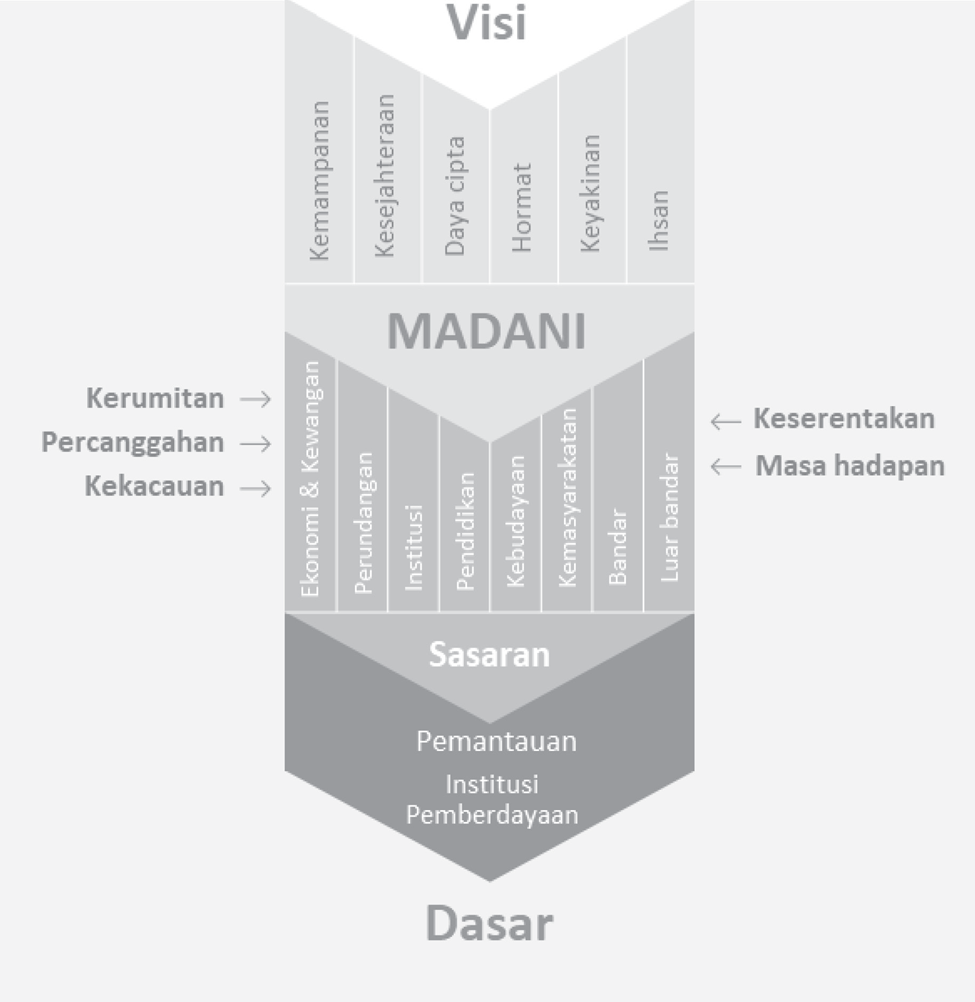
The book has two language versions, the English version is called 'SCRIPT for a better Malaysia'. In the Malay version, Anwar has taken the alphabets in the 6 drivers for the policy framework he has set out to represent 'MADANI': Sustainability, Prosperity, Innovation, Respect, Trust, Care and Compassion. Anwar is one of the first leaders, probably as early as the 90s, to introduce the term 'Masyarakat Madani' to mean 'civil society'. Obviously, he prefers Madani because his reputation is built on the social and Islamic religious movements in his youth.

Why a relaunch? The response to the first publication was lukewarm at best, but now Anwar is doing this in the name of the Prime Minister, so it has received a different level of attention, especially now that he has made Malaysia Madani a slogan for his government.

The book serves as a document detailing his vision, values and political narrative as a leader, especially in the period after he was released from prison in 2018, returned to Parliament and acted as Prime Minister-in-waiting. The Sheraton Move and the COVID-19 pandemic disrupted his agenda.

The book is not a manifesto for Anwar's party, it lacks detailed policy descriptions and is rather complicated. The 6 drivers were examined under 8 policy imperatives, analysing their complexities and conflicts, as well as how they could be monitored and implemented through institutions.

So, to fully understand what he meant by Malaysia Madani, one has to slowly read and digest his words in the book, and it is not an easy read. He has such a tendency to use certain uncommon vocabulary, to incorporate what he knew or experienced from his long-term observation and analysis, and certainly to show off his knowledge acquired from his extensive reading habits.

However, unlike previous prime ministers, Anwar was once a political prisoner and a student activist, and it was these experiences, along with his extraordinary command of language and depth of knowledge, that determined the slogan and image he chose to present to the nation.

The recurring themes in the book are: good governance, rejecting corruption and abuse of power; building an inclusive society where people respect each other; overcoming poverty and wealth inequality; sustainable development to protect the environment, mitigate natural disasters and rein in rapacious capitalism. These are likely to be Anwar’s priorities as Prime Minister.

The positive implications of Malaysia Madani for Anwar are that the people would perceive that Anwar and the new government have their distinctive values and new ideas, thus increasing the people's confidence in the unity government. Anwar can also use the opportunity to unite the various component parties under the new government and try to find an internal consensus for all.

Anwar's 6 drivers in Malaysia Madani may be incisive, but they are at most principles and general directions, people are familiar with some of the issues and problems raised by Anwar. In fact, the key should be how the changes are implemented. It could be said that the slogans such as "Keluarga Malaysia" (Malaysian Family), "Prihatin Rakyat" (Care for the People) and "1Malaysia" which were lauded in the past, do not seem outdated in today's context, but have the previous prime ministers successfully implemented policies according to the slogan concept?

Compared to the previous slogans, the biggest problem with Malaysia Madani is that it is too difficult for the general public to understand, let alone his cabinet colleagues and senior civil servants. The 6 drivers are also not easy to remember. This could weaken the campaign's popularity by making it harder to resonate with the people.

It is foreseeable that politicians would selectively use the Malaysia Madani drivers as a label to refer to the policies they advocate. Under this unity government, even their respective party manifestos are not yet integrated, so it would be too much to say that Malaysia Madani values should be implemented now. It must also be recognised that the ruling component parties have quite different political values, with GPS and GRS tending towards regionalism, while UMNO is still committed to a Bumiputera First policy. There could be political conflict, especially now that Perikatan Nasional, the main opposition is mounting a serious political challenge, could the unity government withstand the pressure and continue to uphold the lines and principles of multi-racial, multi-religious and multiculturalism as outlined in the Madani book?

Malaysia Madani is just a collection of Anwar's personal political narratives and beliefs; it could not be easily translated into actions and policies as he still has to face and overcome the challenge of the old order, politics and culture. How far Malaysia Madani can go depends on Anwar's tenure as prime minister and how he manoeuvres the implementation of his grand vision.

Thursday, February 16, 2023

昌明大馬治國口號能有效?(未編輯的原稿)

自從昌明大馬(Malaysia Madani)理念經由首相安華於119日在布城國際展覽中心再次推介,儼然成為了安華和希盟主導的新團結政府的治國口號。

為何說再次推介?其實昌明大馬這口號源自於安華的一本政治思想和政策框架著作,早在去年102日,於首邦市一家酒店宴會廳已推介了。這一本著作有兩個語文版本,馬來文版的書名稱為“Membangun Negara MADANI”(《建造公民社會國家》,簡略為《建》),英文版的題為“SCRIPT for a better Malaysia”(《更好大馬的劇本》)。昌明大馬很明顯就是取自馬來文版的書名。而MADANISCRIPT是縮寫,分別以馬英文代表了書中的六大原則:永續、繁榮、創造力、尊重、信任和關懷。安華是其中最早在90年代就率先提出Masyarakat Madani這詞彙的人物,那詞彙代表文明社會civil society的意思。出身社會群眾運動和伊斯蘭教運動的他對Madani情有獨鐘。

首度推介這本著作時,未掀起太大的漣漪。當時還未舉行大選,安華僅是希盟的共主和人民公正黨主席。希盟的競選宣言要遲至1個月後才出爐。所以在今年1月重新推介昌明大馬時人們誤以為是全新的概念。當然這次推介的身份是首相,所以這理念獲得高度關注。那麼為何還要重來一次呢?

安華在2018年獲釋出獄,當時就是等待接棒的希盟首相人選。重返政治回到國會後,馬哈迪似乎不願守承諾交棒,不少支持者就勸請安華要為拜相做好準備,要鋪陳自己一套的政治論述和執政理想,塑造准首相的形象。那時的安華馬不停蹄地全國跑透透演講為自己造勢和聆聽民眾的聲音和意見。書中有提到一些當初為他量身打造的運動如DNA23用以接近年輕人和倡導數碼經濟。後來喜來登政變和新冠疫情來襲中斷了他的拜相政治議程。

昌明大馬的腳本《建》是一本217頁厚的書,書中闡明這有關安華個人的政治思想觀點和政策框架。畢竟它不是競選宣言,缺乏詳細的政策細節內容。書中表明要用六大原則來體現昌明大馬,還要相當系統地通過8大層面檢驗政策,分析該理念的複雜度和相衝之處,並提出如何監督和促使制度改革的策略。安華表示,六大原則有連貫性、相輔相成的。影響他撰寫這本書的參考文獻就有258個,單單是安華撰寫的前言就用了18頁。


換句話說,若要真正全面明白安華有關昌明大馬的政治思想,就得慢慢地去了解和消化他的文字。這不是一件容易的事---除了他的語文根底深厚用了不少鮮為人知的生澀字,他也提了很多概念和他在過去多年的社會政治經濟文化觀察與分析,還有他閱讀過眾多的書籍、吸取的知識精華,所謂昌明大馬理念的厚度可媲美《建》書的厚度。

儘管昌明大馬的完整理念不太容易讓民眾乃至高級公務員和內閣同事吸收,這是安華致力打造給人民的形象定位。畢竟安華與過去諸位首相不同,他曾是政治犯度過漫長的牢獄之災,但他愛好閱讀因此閱歷廣闊、知識淵博和充滿墨水,再加上他超凡的語言能力,這些個人特征決定了治國理念和口號的不同,因為他能去得更深更遠。

昌明大馬提到的各大政經文教問題與分析,絕對與當今我國的情況依然相關。在《建》著作裡常提及和重複的論述可看出,安華要的是良好施政拒絕貪腐濫權;要塑造一個包容性高的多元社會,彼此互相尊重;解決貧窮和貧富懸殊問題;要永續發展照顧環境避免災害和貪婪的資本主義。

我認為昌明大馬最大的作用對於首相安華來說,就是有個施政理念的鋪陳和包裝,讓人民看到這新政府似乎有不一樣,對他領導的團結政府會增加了信心。而安華可以用這理念來整合和拉近團結政府下的各政黨,試圖凝聚一個內部共識。

安華提出的六大原則雖然有用,但也充其量是原則和大方向,一些或許是大家都已懂或熟悉的課題,實際上要如何落實才是重點。比如說,過去幾任首相的口號或政治中心思想如大馬一家(Keluarga Malaysia, 關懷人民(Prihatin Rakyat)甚至是一個大馬(1 Malaysia)放在今天的脈絡沒有錯,也沒有過時宜,但他們是否有真正做到了口號的概念?

我也認為,治國理念或口號應該成為一個家喻戶曉的價值觀和精神面貌,明白施政方向和政策,才能有效。它的重要性就如一個品牌的標語,要有效傳達產品訊息。若這個理念或口號太玄太複雜,就難以產生共鳴,減弱了宣傳效果。昌明大馬正面對這個大挑戰:因為比較起過去的大馬一家關懷人民一個大馬,昌明大馬似乎太深奧,6個原則也不太容易記住。

倘若安華繼續沿用這個,明年獨立民調機構應該做個民調試探多少民眾記得全部6個原則?不然昌明大馬只是用來貼在很多政策,人民未必明白其中的內涵。最後可能只會淪為政治人物各自表述,牽扯去昌明大馬的原則,似乎就能說得過去了。這個現象在過去也發生在較易懂的口號大馬一家一個大馬

要知道目前這一個所謂團結大聯合政府,連各黨的競選宣言都還沒統合,現在說要貫徹這個更價值觀原則性質的昌明大馬更是難上加難。這些政黨領袖們或有不同的政治理念和政黨價值觀 , 比如砂盟和沙民聯都傾向地方主義,巫統仍是土著至上主義。當然這些領袖們可從中選擇哪些比較可接受的昌明大馬原則或價值觀,以表示團結在這首相後面,但一些政治矛盾不能被忽略,特別是目前面對國盟在野陣線的政治挑戰。團結政府能不能守住多元種族宗教和文化路線,不被國盟挑釁而右拐?

根據獨立民調機構的截止1月中的民調結果,對安華的滿意度(68%)還要比團結政府的還要高個14個百分比。這點不出奇,因為安華是這個團結政府的核心靈魂人物,他的領導表現就影響了團結政府的形象。他主要獲得一面倒多數的華印裔支持,也有多數的巫裔(60%)支持。這是給安華領導釋放好感和鼓勵。安華應該更加有信心著手處理和解決國內重大課題和中長期的改革方案。

昌明大馬畢竟還是安華自己的政治思想和理念,它不是政黨的競選宣言,得面對舊有政策、制度、文化和秩序的挑戰 --- 要改變不容易、也需要時間。昌明大馬這理念能走多遠多久,就要看安華任相時期的能耐和造化了。

安華的「昌明大馬」能否奏效?

 「昌明大馬」的個人色彩濃厚,是安華的政治思想和理念。其既不是政黨的競選宣言,又必須面對既有政策、制度、文化和秩序的挑戰。安華要著手改變這些問題並不容易,更需要時間。而這項理念能走多遠,最終還是得看其掌權期間的能耐與造化了。


【文/林志翰】

首相安華(Anwar Ibrahim)於二〇二三年一月十九日,假布城國際展覽中心「再次」推介「昌明大馬」(Malaysia Madani)理念。這也儼然成為安華及其所領導的團結政府提出的治國口號。

為何我說是「再次」推介「昌明大馬」?其實,安華作為出身群眾運動和伊斯蘭運動的領袖,對此詞彙「Madani」情有獨鐘,其亦為一九九〇年代率先提出「Masyarakat Madani」這個詞彙的人物。二〇二二年十月二日,安華將這項理念匯集成書,出版馬來文版著作「Membangun Negara MADANI」(中文譯為《建造公民社會國家》,本文以此稱呼)及英文版著作「SCRIPT for a better Malaysia」(中文譯為《更好大馬的劇本》)。而「MADANI」和「SCRIPT」是縮寫,分別以馬、英文代表書中的六大原則:永續、繁榮、創造力、尊重、信任和關懷。「Masyarakat Madani」這詞彙則有「文明社會」或「civil society」之意。

此著作推介時並未掀起太大的漣漪。只是,如今安華成功當上首相,為何還要「再次」推介「昌明大馬」的理念呢?安華於二〇一八年獲釋出獄,當時就是等待接棒的希盟首相人選。重返國會後,馬哈迪遲遲未信守承諾交棒;而安華也以准首相之形象,積極鋪陳一套政治論述和執政理想,並且馬不停蹄地巡迴全國演講。這麼做既為自己造勢,也聆聽民眾的聲音。可是,喜來登政變和新冠疫情的來襲卻中斷其拜相之路。

爾後,安華出版這本《建造公民社會國家》。此書厚達二百一十七頁,單是前言就有十八頁。這本書作為其拜相的出師表,闡明安華個人的政治思想觀點和政策框架。書中表明要用六大原則體現「昌明大馬」,還相當系統地通過八大層面檢驗政策,分析該理念的複雜之處,並提出監督政府和促使制度改革的策略。安華表示,這六大原則互有連貫,彼此之間相輔相成。

理念艱澀深奧

此外,書中也提到其對於社會、政治、經濟及文化各方面的觀察分析,也有閱讀後書寫的知識精華。政策方面,書中也有提到一些如「數碼原生代」計劃(Digital Native Agenda,DNA23)。當初身为準首相之時,這些政策及計劃皆為他量身打造,以接近年輕人和倡導數位經濟。安華的語文根底深厚,使用不少鮮為人知的生澀字眼,閱讀起來絕非易事。這也是「昌明大馬」不親民的一面,難以讓民眾、高級公務員和內閣同事所理解吸收。

然而,這正是安華與過去諸位首相不同之處。他曾是政治犯,在監獄中度過漫長的歲月。豐富的知識與閱歷皆決定其治國理念和口號有過人之處。「昌明大馬」中提到的各大政經文教問題與分析,當下依然存在。在《建造公民社會國家》中,安華清楚表示,其要的是良好施政,拒絕貪腐濫權;要塑造一個包容的多元社會,彼此互相尊重;解決貧窮和貧富懸殊問題;要永續發展,照顧環境,避免災害及貪婪的資本主義。

我認為,「昌明大馬」最大的作用在於:對內,安華可以將此理念整合和拉近團結政府下的各個政黨,並且試圖凝聚內部共識;對外,則可透過施政理念的鋪陳和包裝,讓人民看到新政府與過往政府不同之處。但是,這項理念充其量是原則和大方向。面對政治現實,政策要如何落實才是重點。過去,我國有許多政治口號及中心思想,例如:「大馬一家」(Keluarga Malaysia)、「關懷人民」(Prihatin Rakyat)及「一個大馬」(1Malaysia)。這些口號放在今天依然符合時宜。只是,歷任首相都未必能真正達成自身所提出的口號。

同時,我也認為,一個治國理念或口號應該是家喻戶曉的價值觀和精神面貌,並且有著廣為人知的施政方向和政策,方能產生效果。其就如一個品牌的標語,必須有效傳達產品訊息。倘若理念或口號過於複雜,難以與民眾產生共鳴,也減弱宣傳效果。而這正是「昌明大馬」面對的挑戰。比起過去的口號,「昌明大馬」顯得太深奧,六個原則也難以讓人留下深刻印象。

須堅守多元路線

如此下來,「昌明大馬」也只是被粘貼在許多政策上,並且淪為政治人物各自表述的符號。而類似的現象也在過往的政治口號中發生。只是,今時不同往日。自第十五屆全國大選結束後,團結政府連各個政黨的競選宣言都尚未統合,政黨領袖們的政治理念及政黨價值觀更是南轅北轍。比如,砂拉越政黨聯盟(GPS)和沙巴人民聯盟(GRS)都傾向地方主義;巫統仍是土著至上主義。

當然,這些政黨領袖們可以在「昌明大馬」的大原則下各取所需,篩選各自所能接受的價值觀,以表示與安華站在同一陣線。然而,面對來勢洶洶的國盟,團結政府能否經得起考驗,彼此之間的政治矛盾能否不被挑起,從而守住多元族群、宗教和文化路線,恐怕才是關鍵。

根據截至二〇二三一月中的民調結果,民眾對於安華的滿意度(68%)比起團結政府高出14%。安華作為團結政府的靈魂人物,其表現影響團結政府的觀感。民調顯示,安華主要獲得華、印群體一面倒的支持,亦獲得60%巫裔的認可。這是對於安華的利好訊息,其更應該著手處理和解決國內重大課題,並且擬定中長期的改革方案。

只是,「昌明大馬」的個人色彩濃厚,是安華的政治思想和理念。其既不是政黨的競選宣言,又必須面對既有政策、制度、文化和秩序的挑戰。安華要著手改變這些問題並不容易,更需要時間。而這項理念能走多遠,最終還是得看其掌權期間的能耐與造化了。


原文鏈接:http://contemporary-review.com.my/2023/02/15/1-504/